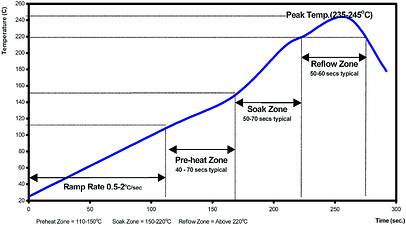
a very difficult thing to do. Don’t use any hot-air stuff. I have broken a few OSD the final result shortcuts 5V to GND inside the chip. The only good way is reballing machine with the profile plus new OSD32 with fabric balls. I suggest something like below
The bottom heater is set to 150C
The upper IR heater profile as follow
It is good on my machine. Sometimes I need to do this process twice, and I don’t know why.
Fabric pieces have balls on pads if You make reballing You need to set balls on PCB. I make a few experiments to give OSD32… on back than stencil + balls and rebaling machine or hotair to solder the balls. This process finished quite good, but when I figurated OSD32… on PCB and even used reballing machine with a good profile always achieved shortcuts on 5Vto GND. It is very strange I have had no issue like this before. This chip is very complicated inside, nano PCB with the IP cores. I feel that some lead during increased temperature leakage on neighbour pads makes shortcuts, of course, inside the chip. I don’t recommend reballing for this OSD32.
The soldering profile is does not change for replacing the part. However, note that you will need to bake the replacement part before you put the board through reflow to avoid any MSL related failures.
I think that baking is not a problem because after achieving a shortcut in 5V to GND and again reballing (reablling I mean chip on back, balls and hot-air) shortcut disappears. But again soldering causes a shortcut between 5V to GND. After such rebaling procedure 1 at 10 times, osd32 is back to normal work. So I guess that some lead material is sometimes short sometimes doesn’t. But this is only my feeling nothing else, I’m not an expert with soldering.
yes, I used the presented profile for this chip, but everything depends on Your soldering machine. I suggest the last phase change to 20 seconds. Nevertheless, remember to bake chips before soldering and adopt the profile to Your board and Your soldering machine. I can’t guarantee success, I made a few tests after achieving a good result.
I am not sure what process the SIP pictured went through. If the SIP experienced delamination and cracking, then solder could come out from inside the SIP(could be MSL issue) but that may not be the cause of problem. Cause could be BGA desoldering process which could overheat the part for quick remove.
Are you replacing or re-using the SIP? If so, you will need to be very careful not to damage the SIP.
You also need to dry bake board before removal and bake part before replacing on the baord. Board drying specs are different (lower T and longer duration).